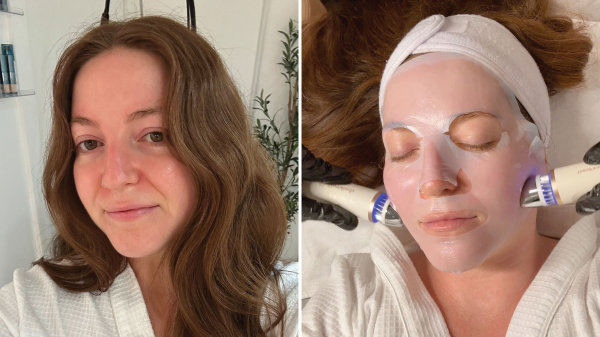

 Photos: Courtesy of subjectSave this storySave this story
Regardless of what you call it—dewy, glass, glazed-donut, or mochi skin—it seems the vast majority of us are in pursuit of the same thing: a bouncy, luminous, ultra-hydrated complexion. I certainly was, especially after a packed summer at the beach. As the temperature dropped, I noticed my face looked dull and lifeless, and while there could be many causes for that, the main culprits for me were dehydration and a buildup of dead skin cells.
A great skin-care routine helps, but it can get you only so far. Once we seem to have reached that plateau, many of us turn to professional-grade treatments for an extra boost. Enter Glacē, Hydrafacial, and DiamondGlow, three facials that supposedly restore your glow. Each of them has zero downtime, is tolerable on most skin types, and is based on a three-part skin-resurfacing regimen: cleansing, exfoliating, and infusing the skin with serums. They’re all performed using similar devices that help vacuum gunk out of blackheads and whiteheads, and help topicals penetrate the skin more effectively.
But what makes these three options stand out in the industry? I tried them all to give you the lowdown.
Glacē
Glacē—pronounced “glassy,” because its main objective is to give you glass skin—is a fairly new treatment, launched in 2025 by Candela. It’s a noninvasive facial that combines hydrodermabrasion (a fancy word for vacuuming pores while pushing actives into your skin), LED light therapy, and lymphatic massage. This is a great facial for anyone looking to boost hydration and radiance, but also experience a cooling and soothing treatment, according to Sameer Bashey, MD, a board-certified dermatologist and clinical instructor in dermatology at the University of Southern California in Los Angeles.
Dr. Bashey had described me to a T, so I booked a visit with Julianny Goncalves, an aesthetician and founder of On Esthetic in lower Manhattan. We started my Glacē treatment with a double cleanse to rid my face of any debris (hello, subway air). Then Goncalves used two TheraFace Depuffing Wands (a two-time Best of Beauty Award winner) on my face and let me relax under a facial steamer for a few minutes to further loosen whatever might be clogging my pores.
She reached for a handheld device equipped with “diamond-integrated disposable tips” for the main event: hydrodermabrasion. (Both Glacē and DiamondGlow have diamond-encrusted tips in the devices used during the exfoliation step, while Hydrafacial recently introduced the feature as an add-on.) “Diamonds are an exceptionally hard material, so tiny diamond particles create a durable, textured surface that buffs away dead skin cells as the wand moves across your face,” says Mona Gohara, MD, a board-certified dermatologist based in Hamden, Connecticut. “Think of a nail buffer smoothing a rough nail, only with a tool designed specifically for skin. Removing that uneven buildup makes skin feel softer and reflect light more evenly, which translates to glow.” Since the intensity is adjustable, this works for a variety of skin types, but it’s not recommended for people with irritated skin or an active eczema or rosacea flare.
As Goncalves swept the device across my face, the suction-y tip felt like a little slug with a very rough tongue licking my face—not unpleasant, but strange nonetheless. I got used to it after a few passes across my face and was able to relax (even with that freaky slug image stuck in my head).
The hydrodermabrasion step.
Courtesy of Elizabeth Gulino
As the diamond tip buffs away dead skin cells, it's designed to simultaneously infuse two serums into the face. One is always for exfoliation, and the other is to target the client's specific skin concerns. The esthetician can choose between four Met2morph serums for the latter, including one for evening skin tone and another to boost the suppleness of aging skin.
Because I have sensitive skin, Goncalves chose a serum called Silky Touch, which, according to Candela’s website, “provides hydrating and restorative agents to soothe and protect reactive skin” via niacinamide, lavender, and cranberry. Dr. Gohara says that while niacinamide helps strengthen the barrier and retain moisture, and cranberry can offer potential antioxidant benefits, lavender may irritate sensitive skin. Personally, I did not find any part of this step irritating.
After we were done using the vacuum wand, we moved on to the lymphatic drainage portion of my treatment, which involved cupping to reduce puffiness and sculpt the skin. Cupping on your face may sound a bit intimidating (I’m sure you’ve seen those huge, hickey-like red and purple bruises left behind on athletes’ backs from the technique), but this was a much milder and calming version of the modality, thanks to the smaller cup size and gentle suction. In fact, it might’ve been my favorite part of the process.
Goncalves then applied a soothing sheet mask paired, again, with two TheraFace Depuffing Wands, a feeling I’d equate to entering the gates of heaven. Then I sat under an LED light treatment to reduce inflammation for about 10 minutes before having a thin layer of SPF massaged onto my skin.
Adding a TheraFace Depuffing Wand to my facial must-have list.
Courtesy of Elizabeth Gulino
My face tends to get red during facial treatments, but as I left On Esthetic, my skin was immediately glowing. My complexion looked like I had just emerged from the womb: It felt clean and bouncy to the touch. My pores looked smaller, my skin had luminosity, and my self-confidence soared. If only I’d had somewhere to go besides NJ Transit to catch a train. Luckily, the effects of this particular facial can last up to two weeks.
How much is a Glacē facial, and is it worth the cost?
Goncalves says that for those who can spare the funds, getting the treatment once a month is ideal (no need for any more, though she says she has patients who beg to come back ASAP). With average prices ranging from $150 to $350, that’s a substantial monthly splurge. But if you want to treat yourself before a big occasion, like a formal event, a wedding, or your 30th birthday, I think it’s totally worth it. Out of the three facials, this one left me with the brightest and clearest complexion immediately after.

Before the Glacē treatment.

After the Glacē treatment.
Hydrafacial
The TL;DR is that Hydrafacial is “a hydration tool that also decongests and sucks all the gook out of your pores,” according to Corey Hartman, MD, a board-certified dermatologist in Birmingham, Alabama, who is a paid consultant for the brand. “It can give the patient that red-carpet look with no downtime.” This particular facial would be great for someone with clogged pores, blackheads, oiliness, or dehydration, Dr. Bashey adds.
Instead of using a crystal-encrusted tip for physical exfoliation, Hydrafacial starts with a mix of glycolic and salicylic acid serums to provide chemical exfoliation. (The brand recently started offering the use of a diamond-encrusted exfoliation tool for an extra fee, which is set by providers.) A patented plastic spiral tip and patented Vortex-Infusion technology work together to apply the exfoliating serums to the face.
Dr. Gohara acknowledges that these terms may sound complicated, but the idea is straightforward: “The wand’s spiral-shaped tip helps that fluid circulate across the skin as the provider moves it,” she explains. “Think of washing a floor with a machine that puts down clean water and picks up the dirty water, rather than pushing the same wet mop around.”
I went to Skin Spa in Flatiron for a Deluxe treatment, which is the mid-tier version of the facial. (Hydrafacial offers an entry-level, Signature treatment, and the top-tier is dubbed Platinum. Each level exfoliates, extracts, and saturates the skin's surface with serums—more steps are added as treatment levels up.) After cleansing my skin, my esthetician, Alisa, had me put on protective eye gear similar to small tanning goggles to shield my eyes from any spraying serums. They blocked out light but did not feel uncomfortable or obstructive.
Then we went on to the first portion of the facial: lymphatic drainage. This step involves running two clear glass tubes along my face to reduce puffiness and firm up the skin. This was extremely similar to Glacē’s cupping step and was probably the most relaxing part of the facial for me. Then we did a light chemical peel with the glycolic and salicylic acid mixture, which made my face feel hot and tingly, a normal side effect of acids for my sensitive skin.
My chemical exfoliation was immediately followed by a spicy mechanical exfoliation, which involved a wand-like tool that utilized suction and a whirling vortex of water to flush gunk out of my pores. That same tool helped infuse serum into my skin, which felt similar to Glacē’s. Also like Glacē, Hydrafacial offers add-on boosters for an additional cost that aid with concerns like dullness and acne. We used the DermaBuilder, a “peptide-infused serum booster,” that is supposed to improve skin laxity. The session ended with an LED red light treatment to reduce inflammation and stimulate collagen production, and a layer of SPF.
How much is a Hydrafacial facial, and is it worth the cost?
A Signature Hydrafacial treatment is around $150 to $350 depending on the provider, location, and treatment type. The range can also increase depending on whether you choose a deluxe or platinum treatment. The price is fair, especially since you can book the lowest tier and still receive a glowy result from the exfoliation. Maybe I wouldn’t plan a dinner or a night out on the town after this particular facial since it left me feeling and looking red, sensitive, and tight, but those side effects aren't out of the ordinary for many people after exfoliation.
By the next morning, my skin had settled down, and I looked pretty dewy and glowy for days—including at my engagement party, which was just two days after the treatment. I would choose Hydrafacial again, but if I wanted to commit to a monthly treatment, I’d definitely choose the lowest tier, Signature, to save some cash.

Before the Hydrafacial treatment.

After the Hydrafacial treatment.
DiamondGlow
For my final facial, I went to Shafer Clinic Fifth Avenue to see esthetician Edyta Jarosz for a DiamondGlow treatment. She describes DiamondGlow as an experience that exfoliates, extracts, and uses a SkinMedica serum customized for you. (Both DiamondGlow and SkinMedica are owned by Allergen Aesthetics.) While Hydrafacial involves chemical exfoliants, this facial, like Glacē, uses a wand with a diamond-infused tip for physical exfoliation, as well as a similar vacuum-like mechanism to suck away dirt and debris.
DiamondGlow can be performed as a shorter, standalone treatment or incorporated into a longer facial, depending on the client and what their skin needs. “It can be a great option for regular skin maintenance, but I also love it before special occasions because there is minimal downtime,” Jarosz says. “I’ve incorporated it into facials ahead of weddings, red-carpet events, and other occasions when clients want their skin to look fresh, smooth, and glowing.” According to Dr. Bashey, a DiamondGlow facial would be good for someone whose biggest concern is roughness, dullness, or uneven surface texture and who wants more emphasis on physical exfoliation.
Jarosz using the DiamondGlow wand.
After a quick but thorough cleanse to rid my skin of any debris, Jarosz immediately reached for the DiamondGlow wand. It looked and felt similar to both Hydrafacial and Glacē, but unlike those two, the device extracts, exfoliates, and infuses at the same time, so there’s only one step to complete the trifecta.
There are four different diamond tips your esthetician can choose, ranging from low to high levels of exfoliation. After evaluating my skin, Jarosz picked one that would give me a moderate level of exfoliation. Because I was dealing with some dryness at the time of my appointment, Jarosz chose SkinMedica’s Hydra Collagen Hydrator for my serum infusion. (There are four more serums—for smoothing, brightening, clarifying, and correcting—in the DiamondGlow lineup.) This was the only facial that also infused serum into my lips. Again, like the Glacē facial, this part felt like a slug with a rough tongue licking my face, a weirdly pleasant sensation.
From there, a steamer was pointed at my face while Jarosz performed a facial massage. (She calls this her “Lift, Sculpt, and Slap” method.) She used her hands, two gua shas, and, because I have sensitive skin, added an ionized oxygen infuser that, she says, enables the serums to penetrate deeper into the skin. (Currently, Dr. Gohara says there aren’t definitive studies that have shown these infusers lead to deeper delivery, and the claim needs better clinical evidence.)
I love getting my face massaged. I have a tendency to clench my jaw, so having Jarosz knead my face helped release some of that tension. She then used an LED light wand all over my face to minimize redness, and finished with more steam and five minutes under an LED panel to reduce inflammation.
The LED light wand in action.
How much is a DiamondGlow facial, and is it worth the cost?
Jarosz’s facials are a premium experience—they start at $500—but a straightforward DiamondGlow facial is typically less, ranging from $150 to $300 per treatment. As with Hydrafacial and Glacē, pricing also depends on the provider and location. I enjoyed that only one pass of the wand-like device was needed, which left more time for luxe add-ons like the facial massage. While I wasn’t as immediately glowy as after the Glacē facial, I do think the end result had longevity—I received compliments on my complexion for at least a week afterward and felt especially confident going makeup-free. I’d come back for a DiamondGlow facial before a special event or if my skin texture is feeling especially rough. This facial, in particular, tends to offer a deeper level of physical exfoliation than the other two.

Before the DiamondGlow treatment.

After the DiamondGlow treatment.
What to consider before getting Glacē, Hydrafacial, or DiamondGlow
Although the treatments are customizable, you should not get one if your skin is chapped, irritated, or broken—that includes open wounds, like acne or cold sores, active dermatitis or eczema, rosacea inflammation, and sunburn. “Exfoliating an already compromised skin barrier can amplify inflammation rather than deliver that coveted glow,” says Dr. Gohara. “Tell your provider about allergies, pregnancy or breastfeeding, medications, especially isotretinoin and topical retinoids, and recent peels, lasers, injectables, or facial surgery.” Dr. Gohara adds that restrictions vary by device, so a proper consultation should be part of the treatment.
Each person’s experience and preference with facials is, of course, uniquely their own, and each esthetician has their own method for specific treatments. “The person performing the treatment matters tremendously,” Dr. Bashey says. “These devices are tools. Appropriate patient selection, choosing the correct settings and serums, and understanding someone's underlying skin condition can be just as important as the name of the device.”
These facials also won’t solve skin issues like acne scarring, deep wrinkles, substantial pigmentation, or skin laxity, Dr. Bashey notes. “Those concerns may be better addressed with treatments such as lasers, chemical peels, microneedling, radiofrequency devices, or other dermatologist-directed therapies depending on the individual,” he says.
Too much exfoliation can also wreak havoc on your skin barrier, which could lead to breakouts and irritation, so you definitely don’t need to be getting one of these treatments every week. Dr. Gohara says that getting an exfoliating facial quarterly works best. “[They] give you a seasonal refresh without chasing constant exfoliation,” she says. “That’s my conservative maintenance recommendation, not a proven safety limit.”
Which facial is right for you?
If you’re still stuck on which facial to get, think about what it is that your skin really needs. If hydration is your primary goal, I'd recommend going with Hydrafacial. If you’re experiencing dullness, DiamondGlow offers an antidote to rough skin, and I think Glacē would be your best bet before a big event since the results, at least in my experience, are most immediate. “Ultimately, these are relatively low-risk procedures when they're performed appropriately, but the treatment should still be selected based on the person's skin rather than simply choosing whichever device happens to be trending,” Dr. Bashey says. “The best facial isn't necessarily the newest or most aggressive one. It's the one that matches what your skin actually needs.”
What we like about facials is often subjective. I’d bet that a bunch of people reading this ride for Hydrafacial and Hydrafacial only, and maybe just as many like to book a bare-bones facial on Groupon once a year and are 100% satisfied with their results. All I know is that each one of these left my skin glowing, and any of them would be a stellar addition to an already established skin-care routine.